NEXQ Lab

The Next-generation EXascale and Quantum systems (NEXQ) lab works on Quantum Computing Systems, and Resilient HPC and AI Systems.

Research Directions

Quantum-HPC Driven Scientific Discovery
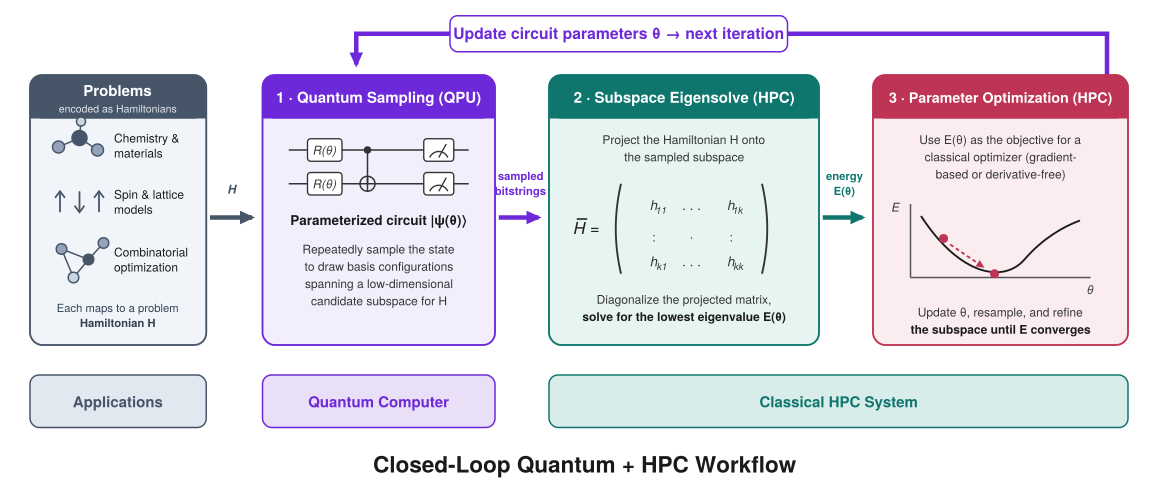
Closed-loop quantum and HPC workflow. Application problems in chemistry and materials, spin and lattice models, and combinatorial optimization are encoded as a Hamiltonian H. Step 1, on the QPU, samples a parameterized circuit to draw basis configurations spanning a low-dimensional candidate subspace. Step 2, on the classical HPC system, projects H onto that subspace and diagonalizes it for the lowest eigenvalue E(theta). Step 3, also on HPC, uses E(theta) as the objective for a classical optimizer, which updates the circuit parameters for the next iteration.

A quantum processor is not a replacement for a classical computer — it is a new kind of accelerator. What it does best is sample from probability distributions that classical machines cannot reach. We design workflows that let each machine do what it is good at: the quantum processor proposes a small, promising subspace, and the HPC system solves and refines it at scale.

AI–HPC Co-Design
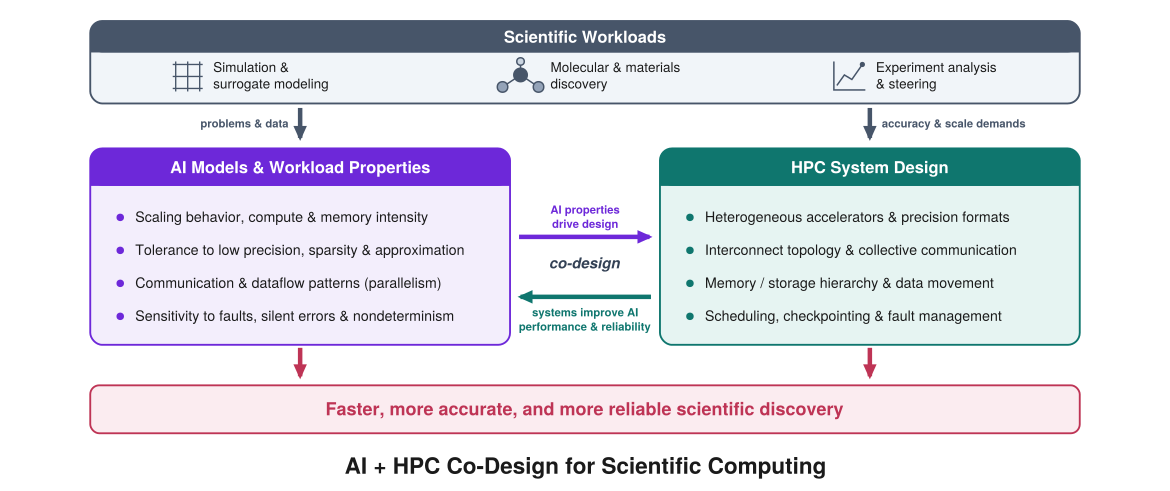
AI and HPC co-design for scientific computing. Scientific workloads — simulation and surrogate modeling, molecular and materials discovery, and experiment analysis and steering — send problems and data to AI models, and accuracy and scale demands to HPC system design. AI workload properties (scaling behavior, tolerance to low precision, communication and dataflow patterns, sensitivity to faults) drive system design, while systems (heterogeneous accelerators and precision formats, interconnect topology, memory and storage hierarchy, scheduling and fault management) improve AI performance and reliability. Together they yield faster, more accurate, and more reliable scientific discovery.

AI workloads have distinctive properties — predictable scaling, precision tolerance, structured communication, fault sensitivity — that should guide HPC system design. In return, well-designed systems make AI faster, more reliable, and more reproducible. This co-design loop determines how fast and how trustworthy AI-driven discovery can be.

PhD Students

Mark Dubynskyi
Mark Dubynskyi
Also affiliated with the Department of Mathematics
Zubair Faruqui
Zubair Faruqui
Xi Ai
Xi Ai

Undergraduate Students